The Road to Theyyam : A Journey Through Malabar

I didn’t go to North Kerala looking for a checklist.
I went looking for something I didn’t fully understand — a ritual called Theyyam.
There wasn’t much information to go on. A few scattered mentions online, no clear maps, no exact locations. Just a name, a district — Kannur — and a week-long festival that seemed to appear and disappear without leaving much trace.
So we went anyway.
The Long Way In
We landed in Mumbai before sunrise and waited out the early hours at the airport, watching the city wake up. By late morning, we were on the Netravati Express — an 18-hour journey heading south.
That train ride does something to you. It slowly removes the familiar. The rhythm of the tracks, the heat through open windows, vendors calling out food, families sharing meals — somewhere along the way, you stop being a visitor and start becoming part of the movement.
By the time we reached Kannur at dawn, we were ready.
Finding Theyyam
Kannur felt quiet. Small. Almost hesitant.
We had breakfast at a simple local place — poori, chutney, sambar — and then began asking around for the festival. No one seemed to understand what we meant at first. The name didn’t translate easily across accents and languages.
At a roadside junction, after a few attempts and a lot of gestures, a rickshaw driver finally nodded. He didn’t speak much English, but he knew where to go.
That was enough.
The First Night
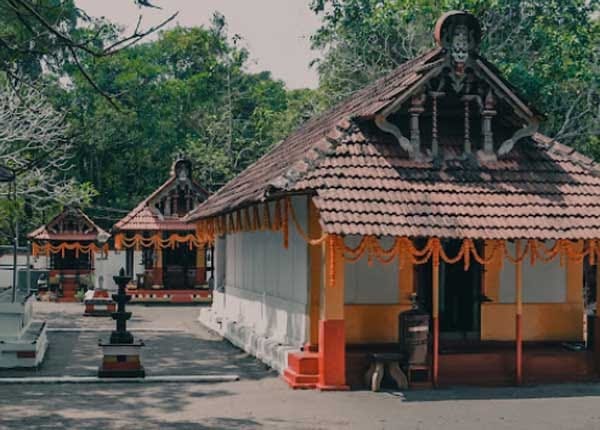
The road narrowed as we left town. Houses thinned out. Trees closed in. After half an hour, we arrived at a small temple, set slightly below ground level, almost hidden.
It was quiet.
A few men were setting up lights. Stalls nearby suggested something bigger was coming. We tried asking when it would begin — eventually understood: 10 PM.
So we returned that night.
Under a full moon, the place had transformed. A crowd had gathered. Drums had begun.
As we stepped closer, an elderly man — slightly unsteady, but warm — took us by the hand and led us forward, placing us right at the edge of the performance.
No tickets. No instructions. Just inclusion.
When the Ritual Begins
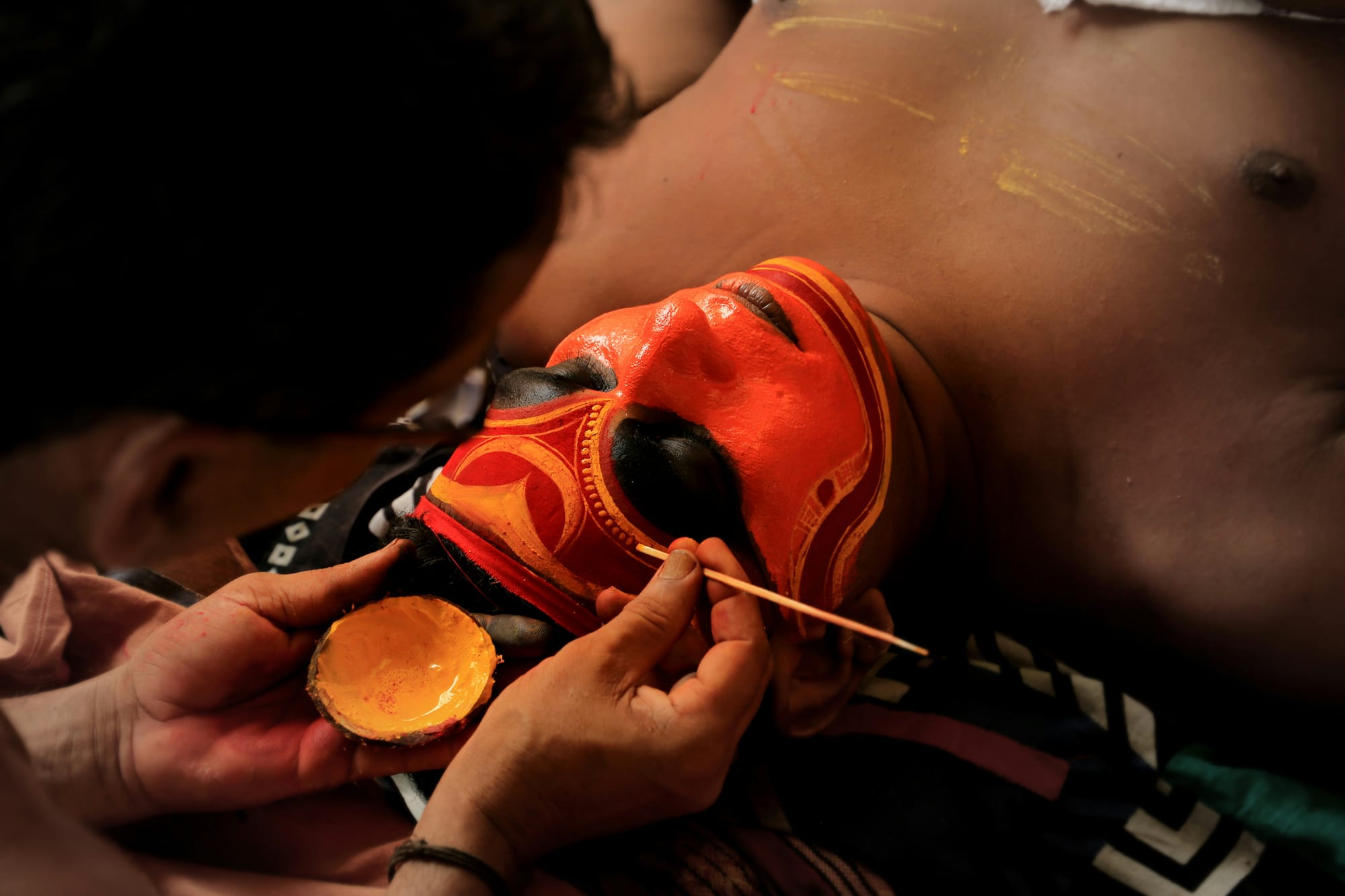
The Theyyam we witnessed was called Vishnumoorthi.
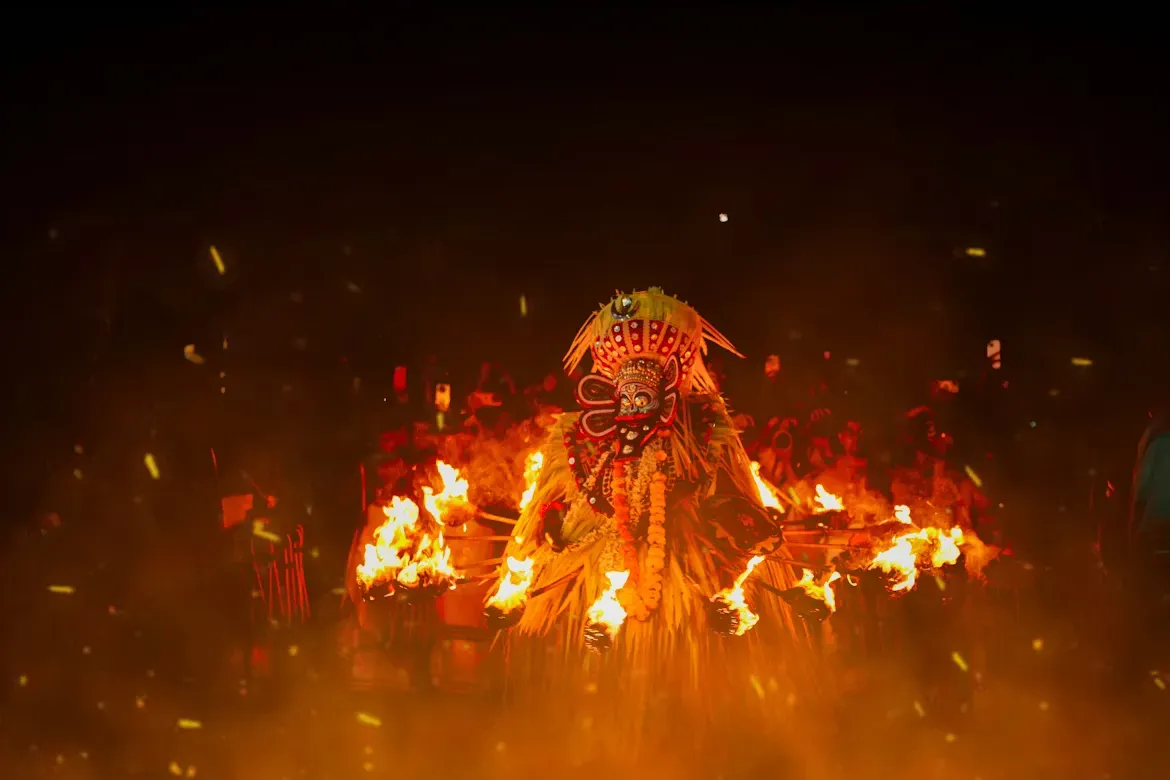
It didn’t begin with spectacle. It began with a story — recited slowly, rhythm building with drums that rose and fell like breath. I didn’t understand the words, but the emotion carried through clearly.
Tension gathered over time.
And then, at its peak — something shifted.
It wasn’t performance anymore. The dancer wasn’t playing a role. He had become something else entirely — something the crowd treated with complete belief.
You don’t analyse a moment like that. You just stand there and feel it.
The Unexpected Invitation
After the ritual, a group of young boys approached us and asked us to stay.
“There is another dance,” they said. Koladi.
We followed them to the back of the temple — a small open square lit by a single oil lamp.
About a dozen boys, bare-chested, sat in a circle with bamboo sticks. They began to sing — one voice leading, the rest repeating. The rhythm was precise, almost mathematical, as they struck their own sticks and those of their neighbours in patterns that never seemed to break.
It was raw, coordinated, alive.
And what stayed with me wasn’t just the dance — it was the ease with which they moved between worlds. Smartphones in their pockets, global culture within reach — and yet here they were, performing something ancient with complete pride.
No hesitation. No irony.
The Walk Back
We tried to find a ride back. The only driver available was in no condition to drive.
So we walked.
Seven kilometres. In the middle of the night. By memory alone.
The full moon lit the road just enough. The air was still. Occasionally, we passed someone — a group of young men, a stray dog, distant sounds of life.
We didn’t get lost.
By the time we reached our hotel, our feet were blistered — but we were smiling.
The Morning After
We returned the next morning.
Daylight changed everything. The same space felt grounded, familiar. More people approached us now — conversations came easier.
One of them, Vasantha, had returned to the village after decades working abroad. He spoke fluent English and took the time to explain what we had seen the previous night.
Later, he invited us to join a meal at the temple.
We didn’t hesitate.
A Meal and a Home
Lunch was simple — rice, curries, something lightly spiced to drink. Nothing elaborate, nothing curated. Just food shared in a space that felt both ordinary and meaningful.
Afterwards, Vasantha took us to his home.
It stood out — larger than the others, built with years of work abroad. Inside, it was both modern and deeply rooted — polished floors, family photographs, a small shrine, an aquarium quietly humming in the background.
We sat, talked, shared stories.
There was no grand takeaway, no lesson being taught — just the quiet clarity of someone choosing to return.
Another Ritual
That afternoon, another Theyyam began.
This one was more elaborate — a towering headdress, carefully assembled and balanced by multiple hands. The dancer moved slowly at first, supported when needed, and then with growing intensity as the drums picked up again.
It was heavier. Louder. More dramatic.
And yet, what stayed with me wasn’t the scale — it was the continuity.
The sense that this wasn’t a performance put on for an audience, but something that would have happened regardless of whether we were there or not.
A Different Kind of Morning
The next morning, I woke before sunrise.
There were no alarms — just the layered sounds of the place. A train in the distance. Dogs barking. Roosters announcing the day.
Then came the call to prayer.
And just as it faded, another sound rose — a voice, clear and steady, singing a melody that seemed to fill the entire space. It repeated, gently, for several minutes.
I didn’t know what it was at the time. Later, I learned it was a morning prayer — Suprabhatam.
But in that moment, it didn’t need a name.
It was enough to listen.
Moving Through Malabar
We moved on.
Through backwaters where boats moved slowly between villages, carrying people, goods, and the rhythm of daily life.
Through coastal towns where evenings belonged to the sea and the quiet conversations of people sitting along the shore.
Through hills where roads curved into coffee estates and small homes appeared unexpectedly along narrow paths.
Everywhere, the pace shifted just enough to notice things — a shared glance, a conversation that started without effort, a meal that didn’t need explanation.
What Stayed
We ended the journey further south, in places more familiar to travellers — colonial streets, cafés, curated experiences.
They were beautiful in their own way.
But my mind kept returning to that first night.
The narrow road.
The hidden temple.
The rhythm of drums.
The boys with bamboo sticks.
The long walk back under the moon.
And Even Later
That night, back in our room, the ceiling fan turned slowly above us.
It made a sound — steady, repetitive.
For a moment, it felt like the drums had followed us.
And perhaps, in some small way, they had.